 ultimate-guide
Integrated Home Entertainment Systems: A 2026 Guide
Table of Contents
- What Makes an Integrated Home Entertainment System Different
- Core Components: Surround Sound, Display, and AV Control
- Best Home Cinema Projectors for Premium Installations
- Acoustic Room Treatment and Cable Management
- Home Theater System Installation: Professional vs. DIY
- Whole Home Audio System Cost and Budget Planning
- Smart Home Integration and Control
- Future-Proofing, Energy Efficiency, and Long-Term Maintenance
- Frequently Asked Questions
Last Updated: October 4, 2026
What Makes an Integrated Home Entertainment System Different
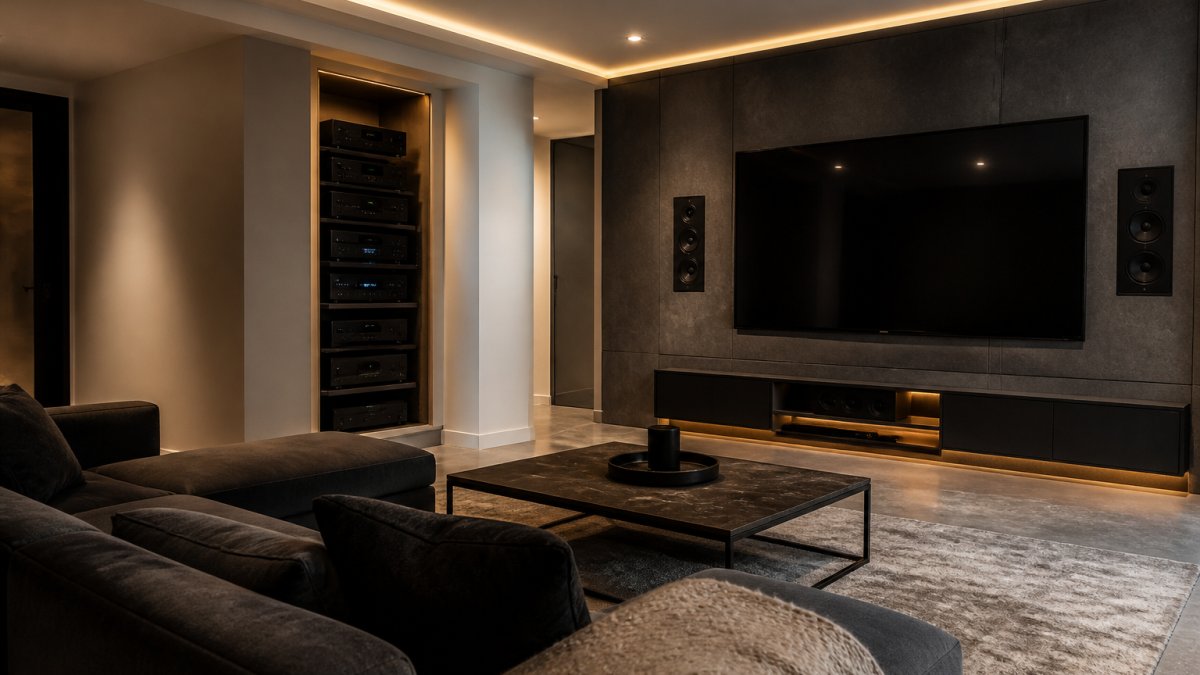
An integrated home entertainment system combines audio, video, and control technologies into a unified ecosystem where every component communicates seamlessly.
The core difference lies in orchestration. A traditional setup forces you to manage each piece independently: one remote for the receiver, another for the projector, a third for the streaming device. An integrated home entertainment system eliminates that friction.
A moderately priced projector paired with a well-designed AV receiver, proper acoustic treatment, and thoughtful cable management consistently outperforms expensive standalone equipment in disconnected setups.

The investment in integration pays dividends in usability and longevity. Systems that work together age better because you're not replacing individual pieces randomly, you're upgrading as a cohesive unit.
Core Components: Surround Sound, Display, and AV Control
An integrated home entertainment system rests on three foundational pillars: surround sound reproduction, display technology, and centralized AV control. These three elements must work together to create the immersive experience that separates a premium installation from a basic one.
Surround Sound System Configuration
Surround sound isn't about volume, it's about placement and precision.
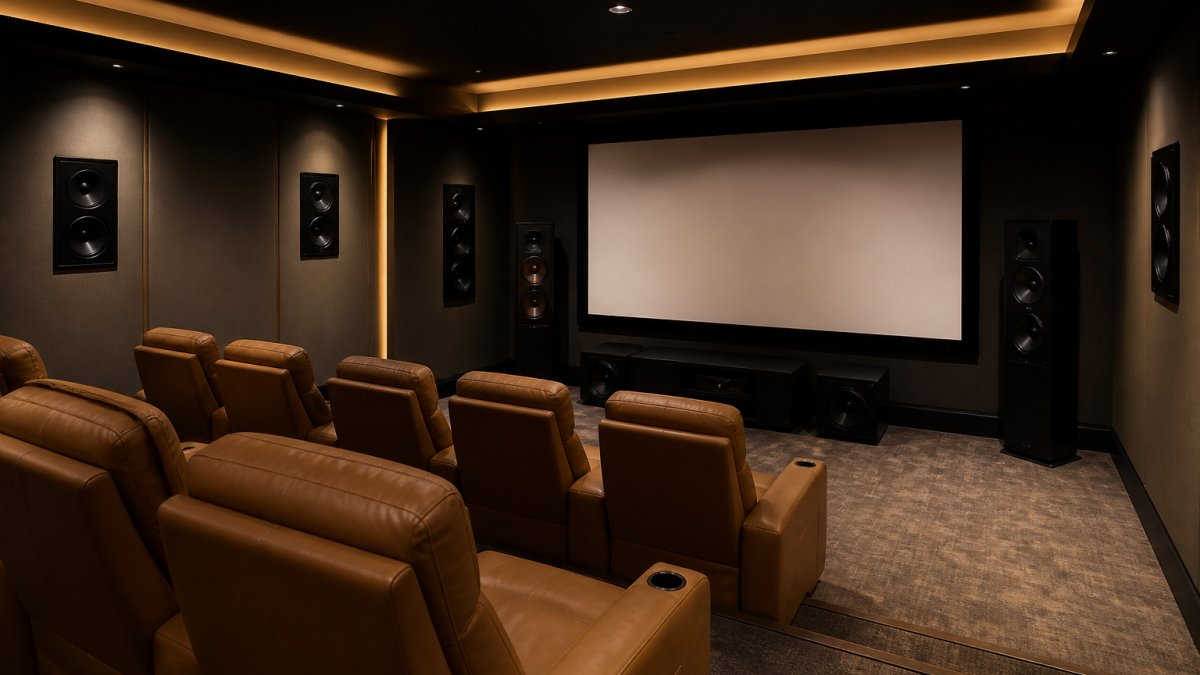
The industry standard for home theater starts at 5.1.2 channel configuration: five main speakers (left, center, right, surround left, surround right) plus one subwoofer for low-frequency effects, and two height channels for overhead audio.
An AV receiver acts as the hub for this system. The Channel Vision A4623 amplified AV controller represents a practical solution for whole-house audio distribution, offering six zones with built-in amplification and pre-amp outputs for more demanding installations.
Speaker placement matters more than speaker cost. Surround speakers should sit at ear level when seated, typically 1-2 feet above the listening position. Height channels mount near the ceiling.
Calibration brings everything together. Many receivers include automatic calibration systems that measure distances, levels, and frequency response to optimize the system. Manual calibration, adjusting individual speaker levels and delay times, refines this further.
Display and Screen Selection
Your display technology defines the visual foundation of an integrated home entertainment system. The choice between projection and direct-view displays depends on room size, ambient light control, and budget.
Projection systems excel in dedicated dark rooms. A quality projector paired with a motorized screen delivers the cinematic experience that television screens cannot match.
Direct-view displays, large-format TVs, work better in rooms with ambient light or multipurpose spaces. Modern OLED and Mini-LED displays deliver exceptional picture quality with superior contrast compared to older LCD technology. HDMI 2.1 support ensures compatibility with next-generation gaming consoles and future streaming standards.
Screen size should match viewing distance. A common rule suggests seating distance divided by 1.5 for comfortable viewing angles. A 10-foot seating distance supports a 65-75 inch display or a 120+ inch projection screen.
AV Receiver and Amplification
The AV receiver orchestrates your entire integrated home entertainment system. It decodes audio formats, switches video inputs, manages room calibration, and amplifies speaker channels. A quality receiver provides multiple HDMI inputs with support for current standards (HDMI 2.1 for 4K 120Hz), surround sound decoding (Dolby Atmos, DTS:X), and room correction technology.
For larger systems or demanding speaker loads, separate power amplifiers supplement the receiver's built-in amplification. This separation prevents the receiver from working too hard and allows you to optimize amplification for your specific speaker requirements.
Best Home Cinema Projectors for Premium Installations
Home cinema projectors have evolved dramatically. Modern options deliver 4K resolution, dynamic range that rivals direct-view displays, and brightness levels suitable for larger screens.
The distinction between consumer and commercial projectors matters. Consumer models optimize for dark rooms and offer better color accuracy. Commercial projectors prioritize brightness for lit environments.
Key specifications include lumens (brightness), contrast ratio (black level depth), lens shift range (mounting flexibility), and color accuracy. A projector rated for 2000+ lumens handles most dedicated theater rooms. Contrast ratios above 10,000:1 produce convincing black levels. Motorized lens shift allows flexible mounting without image distortion.
Lamp-based projectors remain the most affordable entry point, though they require periodic lamp replacement. Laser-based projectors cost significantly more but offer superior brightness, longer lifespan, and more consistent color over time.
Acoustic Room Treatment and Cable Management
An integrated home entertainment system lives or dies based on room acoustics. Even premium components sound mediocre in an untreated room because reflections muddy the audio and create standing waves that emphasize certain frequencies.
Acoustic Treatment Essentials
Acoustic treatment controls reflections and absorbs problematic frequencies. Hard, reflective surfaces (drywall, tile, concrete) bounce sound around the room, creating echoes and phase issues. Soft, absorptive materials dampen this energy.
Bass trapping addresses low-frequency issues. Bass wavelengths are long, a 40Hz note measures 28 feet, so bass energy accumulates in room corners where walls meet. Corner bass traps, typically 12-16 inches deep, absorb this energy and flatten the bass response.
Mid and high-frequency absorption uses softer materials: fiberglass panels, mineral wool, or specialized acoustic foam. Wall-mounted panels behind seating and on first-reflection points (where sound bounces off walls toward listeners) reduce harshness and improve clarity.
The goal isn't complete sound deadening, that creates an unnatural, lifeless environment. Instead, strategic treatment controls reflections while preserving the room's natural acoustics. A common approach treats 20-30% of wall surface area.
Hidden Cable Management
Cable management separates a professional installation from a tangled mess. Integrated home entertainment systems involve dozens of connections: HDMI cables between source devices and receivers, speaker cables from receivers to speakers, power cables, and control wiring.
In-wall cable routing hides wires behind finished surfaces. This requires planning before drywall installation or using surface-mounted conduit in finished spaces. HDMI cables should never run alongside power cables, electromagnetic interference can degrade signal quality. Maintain separation of at least 12 inches where possible.
Label every cable at both ends. When you need to troubleshoot or upgrade components, proper labeling saves hours of confusion. Use a simple numbering system or color-coded tape.
Channel Vision ARIA A4623 4 Input - 6 Zone - 12 CH Amplified A/V Controller →
Cable quality matters for long runs. High-quality shielded cables resist interference better than budget options. For runs exceeding 25 feet, consider active HDMI repeaters to maintain signal integrity.
Home Theater System Installation: Professional vs. DIY
The installation decision hinges on complexity, budget, and your comfort with technical work. Simple systems, a projector, receiver, and basic speakers, can be DIY projects.
Professional installers bring expertise in room acoustics, cable routing, and system calibration. They understand how room dimensions affect bass response and can position speakers optimally. They handle in-wall wiring safely and compliantly.
DIY installation works when you're willing to invest time in research and accept imperfect results. Start with simple configurations: a quality projector, a mid-range AV receiver, and a basic surround speaker setup. Learn through installation, then upgrade incrementally.
The hybrid approach splits the difference. Many homeowners handle component selection and basic assembly while hiring professionals for acoustic treatment design, in-wall wiring, and system calibration. This captures professional expertise where it matters most while reducing overall costs.
Whole Home Audio System Cost and Budget Planning
An integrated home entertainment system for a primary viewing room typically ranges from $3,000 to $15,000 depending on component quality and installation complexity.
Entry-level systems start around $3,000: a solid 4K projector, mid-range AV receiver, basic surround speakers, and subwoofer. This configuration delivers convincing surround sound and quality video without excessive complexity.
Mid-tier systems ($8,000-$12,000) add acoustic treatment, higher-quality speakers with better tonal characteristics, separate power amplification, and professional calibration.
Premium systems ($15,000+) incorporate high-end display technology, audiophile-grade speakers, comprehensive acoustic treatment, and sophisticated control systems.
Consider total cost of ownership beyond initial purchase. Quality components last longer, reducing replacement frequency.
Smart Home Integration and Control
Modern integrated home entertainment systems integrate with broader smart home ecosystems. Voice assistants, mobile apps, and automation routines simplify operation and add convenience.
A quality AV receiver accepts control signals from smart home platforms. This allows voice commands like "watch Netflix" to trigger a sequence: lower the screen, dim lights, switch the receiver to the correct input, and start the streaming app.
Wireless connectivity (Wi-Fi and Bluetooth) reduces physical control devices. Mobile apps let you adjust volume, switch inputs, and manage settings from anywhere in the room or home. This flexibility appeals to households with multiple users and varying technical comfort levels.
Integration quality varies significantly. Some systems require complex setup and offer limited functionality. Others work intuitively with minimal configuration. Test integration before committing to specific components, smooth integration enhances daily usability far more than raw performance specs.
Future-Proofing, Energy Efficiency, and Long-Term Maintenance
An integrated home entertainment system is a long-term investment. Future-proofing and maintenance practices protect that investment and prevent premature obsolescence.
8K resolution is arriving gradually. Current content remains primarily 4K, but next-generation gaming consoles and streaming services will increasingly support 8K.
Energy efficiency reduces operating costs over years of use. Modern AV receivers consume less power than older models, and LED/laser projectors use dramatically less electricity than lamp-based alternatives.
Maintenance extends component lifespan. Lamp-based projectors require periodic lamp replacement (every 2,000-5,000 hours). Laser projectors need less maintenance but cost more upfront.
Modular design future-proofs your system. Rather than replacing everything when one component fails, upgrade individual pieces.
Regular calibration maintenance keeps your system sounding and looking optimal.
Creating an integrated home entertainment system transforms how you experience entertainment at home. The process requires balancing component quality, room acoustics, smart integration, and professional guidance.
Frequently Asked Questions
What components are essential for a fully integrated home entertainment system?
A complete integrated home entertainment system requires four core elements: an AV receiver or amplified controller to manage audio and video signals, a surround sound configuration (typically 5.1.2 channel or higher), a high-quality display or projection system, and acoustic treatment to optimize sound. Smart home integration for lighting and device control, along with proper cable management, elevates the experience further. The Channel Vision A4623 4 Input 6 Zone Amplified A/V Controller ($999.99) exemplifies how a central hub distributes multiple sources across zones while managing both audio and video seamlessly.
How much does a whole home audio system cost?
Whole home audio system costs vary widely based on scope and quality. For example, the MaxView Media Mocha 6-Piece Power Reclining Sectional with Immersive Sound System ($3,299) provides integrated audio within seating itself, while separate amplification and zone distribution systems add significantly to total investment.
What is the difference between integrated home entertainment systems and traditional setups?
Integrated systems centralize control through a single AV receiver or media hub that manages all audio, video, and smart home functions from one interface. Traditional setups rely on separate components with individual remotes and no unified control. Integrated systems distribute content to multiple zones simultaneously, offer calibrated surround sound with precise speaker placement, and enable wireless connectivity across devices. They also simplify installation by using pre-designed configurations and reduce cable clutter through organized management systems.
Should I hire a professional for home theater system installation?
Professional installation is recommended for complex integrated systems involving multiple zones, acoustic treatment, and hidden wiring. Professionals ensure proper speaker calibration, optimal room acoustics, secure mounting, and code-compliant electrical work. DIY installation works for simpler setups with fewer components, but mistakes in speaker placement, calibration, or cable routing can significantly degrade audio and video quality.
Can I integrate smart home controls with my entertainment system?
Yes. Modern integrated home entertainment systems support smart home assistants via wireless connectivity, allowing you to control audio volume, source selection, lighting, and motorized screens through voice commands or mobile apps. Many AV receivers and amplified controllers include IR and serial control options for seamless integration with smart home hubs. This unified control simplifies operation and creates immersive experiences where lighting, audio, and video adjust automatically based on content type or time of day.
What does acoustic room treatment do in a home entertainment system?
Acoustic treatment controls sound reflections and absorption within your room, eliminating echoes, reducing bass buildup, and improving dialogue clarity. Strategically placed panels, bass traps, and diffusers shape how sound travels, ensuring surround speakers deliver precise directional cues and subwoofers integrate smoothly with the main speakers. Proper acoustic treatment maximizes the benefits of high-quality audio equipment and is essential for achieving professional-grade sound in home theater spaces.
How do I choose between a soundbar and a multi-speaker surround sound system?
Soundbars offer convenience and space-saving benefits but deliver limited directional audio and lack true surround channels. Multi-speaker surround sound systems (5.1.2 or higher) provide immersive spatial audio with distinct sounds moving around the room and deeper bass response. Soundbars suit smaller spaces or casual viewing; serious cinephiles and gamers benefit from full surround configurations.