 listicle
Best Home Sauna for Recovery: 2026 Buyer's Guide
Table of Contents
- Quick Comparison: Top Home Saunas for Recovery
- How We Evaluated These Home Saunas
- 1. Thermora Orien Premium 2-Person Low EMF FAR-Infrared Sauna
- 2. Thermora Valen Luxury 2-Person Low EMF FAR Infrared Sauna
- 3. Finnmark FD-2 Full-Spectrum 2-Person Infrared Sauna
- 4. Thermora Ivara Luxury 2-Person Hemlock FAR Infrared Sauna
- 5. Blisspod Venetian RED 2-Person Full-Spectrum Sauna
- 6. Finnmark FD-4 Trinity 2-Person Infrared & Steam Combo
- How Long Should You Stay in a Sauna for Recovery?
- Home Sauna Installation Requirements
- What Matters Most
- Frequently Asked Questions
Last Updated: September 16, 2026
Quick Comparison: Top Home Saunas for Recovery
Finding the best home sauna for recovery means matching heater technology and cabin size to how you train and recover. A far-infrared cabin with low EMF carbon crystal heating and a short heat-up window suits most routines, while full-spectrum and steam combo units serve households wanting spa-level variety. Retreat Elite curates wellness pieces for exactly this decision; the six cabins below are the strongest options in the current catalog.
| Model | Heater Type | Capacity | Price | Best For |
|---|---|---|---|---|
| Thermora Orien Premium | FAR-infrared, ceramic + carbon crystal | 2 person | $2,899.97 | Fast daily recovery sessions |
| Thermora Valen Luxury | Low EMF FAR-infrared, mica carbon | 2 person | $2,999.97 | Panoramic design, smaller spaces |
| Finnmark FD-2 | Full-spectrum infrared | 2 person | $6,399.97 | Deep muscle penetration |
| Thermora Ivara Luxury | FAR-infrared, hemlock | 2 person | $2,999.97 | Plug-in simplicity |
| Blisspod Venetian RED | Full-spectrum + red light | 2 person | $4,999.00 | All-in-one therapy |
| Finnmark FD-4 Trinity | Infrared + steam + red light | 2 person | $8,299.97 | Maximum versatility |
How We Evaluated These Home Saunas
We also weighed practical realities spec sheets skip: whether the unit runs on a standard 120V outlet, how many boxes it ships in, and what replacement parts cost over a decade.

1. Thermora Orien Premium 2-Person Low EMF FAR-Infrared Sauna
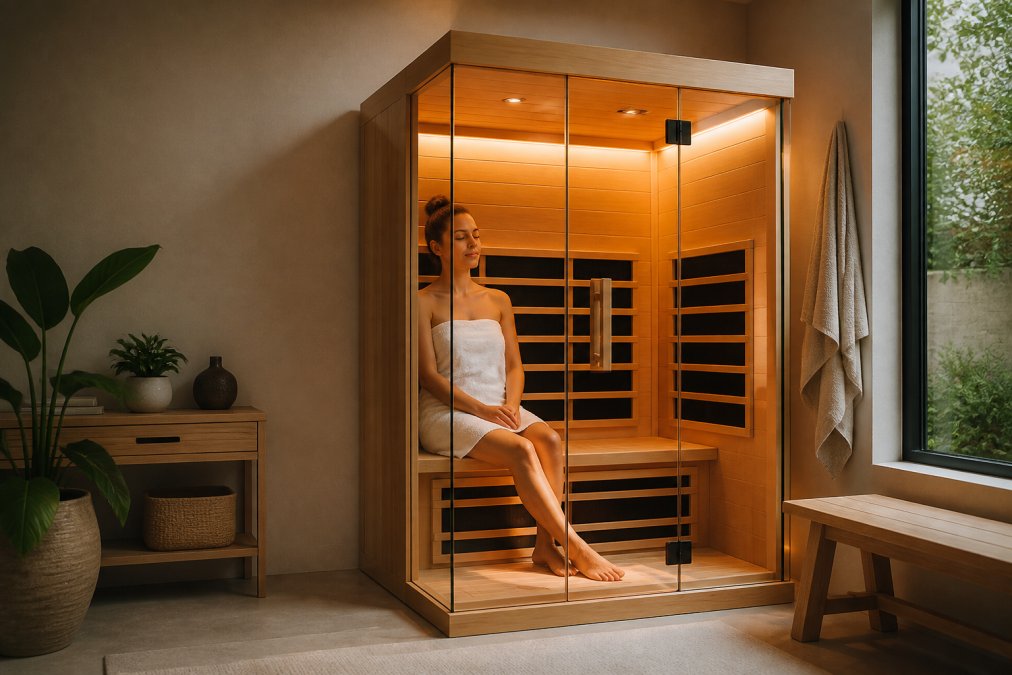
The Thermora Orien is the best home sauna for recovery if you want fast, frequent sessions without an electrician. Its low-EMF FAR-infrared system pairs carbon crystal plates with ceramic tubes, and the cabin reaches useful heat in just 3 to 5 minutes. That short warm-up changes how often you'll actually use it.
- Best for: Post-workout recovery on a daily schedule
- Watch out for: The 60-minute timer caps longer sessions
- Standout: Heat-up in 3 to 5 minutes
2. Thermora Valen Luxury 2-Person Low EMF FAR Infrared Sauna
Panoramic tempered glass sets the Valen apart. The 8mm glass front makes a small wellness room feel open, useful when fitting a sauna into a finished basement or a corner of a home gym. Under the glass, 2000W mica carbon plates and upgraded tubes deliver consistent FAR-infrared heat.
- Best for: Design-conscious installations where sightlines matter
- Watch out for:
- Standout: Panoramic glass and chromotherapy lighting
3. Finnmark FD-2 Full-Spectrum 2-Person Infrared Sauna
Full-spectrum heating is the reason to choose the FD-2. It combines long-wave Carbon 360 panels with UL-listed short-wave Spectrum Plus heaters, pushing heat deeper into muscle tissue than far-infrared alone, ideal for loosening dense muscle after heavy lifting.
- Best for: Athletes wanting deeper tissue penetration
- Watch out for: Higher price than FAR-infrared-only cabins
- Standout: Dual short-wave and long-wave heater blend
4. Thermora Ivara Luxury 2-Person Hemlock FAR Infrared Sauna
Plug-in simplicity defines the Ivara. It runs on a standard household outlet and can be set up in a bedroom, basement, or any ventilated indoor space, removing the wiring project that stops many buyers. Canadian hemlock resists moisture, moths, and corrosion while holding heat efficiently.
- Best for: Renters and anyone avoiding electrical work
- Watch out for: No steam or red light therapy
- Standout: Reflexology floor heater
5. Blisspod Venetian RED 2-Person Full-Spectrum Sauna
Ten heaters and a full-body red light panel make the Venetian RED the most therapy-dense cabin here. Full-spectrum coverage spans near, mid, and far infrared, the large red light panel sits in the front glass for whole-body exposure, and individual heater controls let each person dial in their own intensity.

- Best for: Households wanting infrared and red light in one unit
- Watch out for: Requires a dedicated 20A circuit
- Standout: Full-body red light therapy panel
6. Finnmark FD-4 Trinity 2-Person Infrared & Steam Combo
The Trinity answers a different question: why choose one sauna type when you can have three? It layers infrared, traditional steam, and medical-grade red light therapy in one cabin. A 1.9kW heater lets you splash water on hot rocks for authentic Finnish steam, while Spectrum Plus infrared heaters deliver deep warmth.
- Best for: Buyers who want every modality in one cabin
- Watch out for: Highest price
- Standout: Infrared, steam, and red light in one unit
How Long Should You Stay in a Sauna for Recovery?
Duration is the variable most buyers get wrong: what matters isn't minutes in the cabin but core temperature elevation over time. A 149°F far-infrared cabin and a 190°F traditional cabin can produce a similar recovery stimulus at very different session lengths, which is why copying a friend's 30-minute steam routine into a 122°F infrared cabin usually under-delivers.
A workable framework for most healthy adults:
- Far-infrared (113°F-149°F): 20-40 minutes, with the first 10 minutes treated as ramp-up. Because infrared warms tissue directly rather than the air, perceived effort is lower and sessions can run longer than steam.
- Full-spectrum (up to 170°F): 15-30 minutes. The near-infrared component adds surface and skin exposure, so the ceiling arrives sooner.
- Traditional steam (180°F-195°F): 10-20 minutes, often split into two rounds with a cool-down between.
The post-sauna window most articles skip
The recovery benefit isn't only the heat, it's what you do in the 30 minutes after stepping out. Three protocols worth building into your routine:
- Cool-down contrast. A 1-3 minute cool shower or cold plunge immediately after the session drives vasoconstriction after vasodilation. Without a plunge, a cool shower and 5 minutes of quiet breathing work as a scaled-down version.
- Light movement, not stretching. Five to ten minutes of easy walking or controlled mobility drills is a post-sauna choice.
- Rehydrate with electrolytes, not just water. A 20-30 minute session can produce meaningful fluid loss through sweat. Water alone replaces volume but not sodium, potassium, and magnesium.
Who should shorten or skip sessions
Heat exposure drops blood pressure and raises heart rate, so the calculus changes for some users. Talk to a physician before regular sauna use if you have a history of low blood pressure, heart conditions, are pregnant, or take medications that affect blood pressure or sweating. Stop immediately if you feel dizzy, nauseated, or develop a headache, those are signals to cool down, not push through.
Thermora Alpine Premium 2-Person 3KW →
Home Sauna Installation Requirements
Installation is where most home sauna purchases stall, and the part spec sheets handle worst. Two cabins that look identical on a product page can have completely different electrical demands, determining whether you plug into a wall outlet or hire an electrician for a dedicated run.
Electrical: match the circuit before you order
Start by reading the nameplate wattage, not the marketing copy. The rough math:
- Under ~1,500W at 120V: typically runs on a standard 15A household circuit, provided nothing else heavy shares it.
- ~1,800W-2,000W at 120V: usually needs a 20A circuit. Some units in this range will trip a 15A breaker once the heater cycles on.
- 2,300W and up at 120V: a dedicated 20A circuit is the norm, and it should serve the sauna only.
- 240V models: require a dedicated double-pole circuit and a licensed electrician. This is common on larger traditional and combo cabins.
Space: measure the footprint, not the cabin
Cabins are listed by interior capacity, but the number that decides fit is outer dimension plus clearance. Plan for:
- Door-side clearance: at least 3 feet for entry, towel changes, and stepping out safely.
- Ventilation: infrared cabins are designed to run in enclosed rooms, but the room itself needs air exchange. A basement corner with no airflow will run hotter and damper than the same cabin in an open room.
- Ceiling height: most two-person cabins top out around 75-78 inches. Measure doorways and stairwells on the delivery path, not just the final room, a cabin that fits the space but not the hallway is a return.
- Floor load: a two-person infrared cabin typically weighs 300-450 lbs assembled, spread across its footprint. On a concrete slab this is a non-issue. On an upper floor or a finished basement with a raised subfloor, it's worth a quick check against the room's intended load.
Delivery and assembly reality
Most two-person cabins ship on a pallet in two to four boxes and arrive curbside, so you're responsible for moving them inside, a two-person job for the larger panels. Assembly is typically 45-90 minutes with two people and a screwdriver; panels click or bolt together and the electrical connection is usually a single plug. Budget for pallet and cardboard disposal, because it's substantial.
Long-term cost of ownership
- Electricity: a 2,000W cabin run 30 minutes a day, five days a week, draws roughly 2.5 kWh per session. At a typical residential rate, that's a modest monthly addition, but it scales fast if you run longer or more often.
- Parts: heater panels, controllers, and door seals are the wear items. Ask the manufacturer for replacement pricing before you buy, because a $200 heater panel every few years changes the value math.
- Wood care: cedar and hemlock interiors generally need nothing beyond wiping down, but an exterior that sees humidity or temperature swings benefits from periodic sealing.
The U.S. Consumer Product Safety Commission publishes general electrical safety guidance worth reviewing before any dedicated circuit work, and a licensed electrician should handle anything beyond a standard outlet.
What Matters Most
- Heater wavelength drives recovery quality more than peak temperature
- Low EMF and carbon crystal heating suit daily use
- Heat-up time determines how often you'll actually use the cabin
- Electrical requirements range from standard outlets to dedicated 20A circuits
- Red light and steam add therapy options at higher price points
Choosing the right recovery sauna comes down to matching heater technology and electrical reality to your routine, and that's where expert guidance saves real money. Retreat Elite curates premium wellness pieces with clear specifications, dimensions, and setup details, and our team is available by phone and email to answer questions before you buy. Most orders ship free, and every cabin arrives with the information you need to plan your space.
Frequently Asked Questions
Does a sauna actually help with recovery?
Yes. Sauna heat raises your core temperature and triggers vasodilation, which increases blood flow to tired muscles and can ease soreness after training. Many home sauna listings highlight circulation, muscle relaxation, and post-workout recovery as core benefits. Sessions also support the parasympathetic shift that helps you unwind. For recovery-focused use, look for a model with consistent, penetrating heat, such as the Thermora Orien Premium 2-Person Low EMF FAR-Infrared Sauna, which heats up in 3 to 5 minutes.
What is the 200 rule for saunas?
The 200 rule suggests keeping sauna sessions to roughly 20 minutes at about 200 degrees Fahrenheit. It is a simple guideline for traditional saunas, not a medical standard. Infrared saunas operate at lower temperatures, often between 113 and 149 degrees Fahrenheit, so sessions can run 20 to 30 minutes comfortably. Always hydrate before and after, and step out sooner if you feel lightheaded. If you have low blood pressure or a heart condition, check with your doctor first.
How do infrared saunas differ from traditional saunas for recovery?
Traditional saunas heat the air to 170 to 194 degrees Fahrenheit, creating dry or humid heat that makes you sweat quickly. Infrared saunas warm your body directly with radiant heat at lower ambient temperatures, which some people find easier to tolerate for longer sessions. Full-spectrum units combine near, mid, and far infrared wavelengths. The Finnmark FD-4 Trinity 2-Person combo includes infrared, traditional steam, and red light therapy, so you can switch between recovery styles in one cabin.
What should I look for in a home sauna for post-workout recovery?
Prioritize low EMF heaters, a temperature range that reaches at least 140 degrees Fahrenheit, and even heat distribution across your back and legs. Check the wood: Canadian hemlock and cedar resist moisture and hold heat well. Confirm the electrical requirements, since many 2-person infrared models run on a standard 120V outlet while larger combos may need 220V. Also weigh capacity and seating. The Thermora Valen Luxury 2-Person Low EMF FAR Infrared Sauna offers 2000W mica carbon plates and a 65 to 149 degree Fahrenheit range.
Do home saunas effectively help lower cortisol levels?
Sauna sessions can support relaxation and may help reduce cortisol, the stress hormone, when used as part of a consistent wellness routine. The effect comes from the heat-induced calm and the recovery period afterward, not from a single session. Product listings for models like the Thermora Orien Premium highlight stress relief, improved sleep, and post-workout recovery. Pair sauna use with hydration, cool-down time, and rest for the best results, and avoid intense sessions right before bed if heat keeps you alert.