 how-to
How Do You Choose Luxury Wine Refrigeration?
Last Updated: October 31, 2026
Quick Summary
Choosing luxury wine refrigeration starts with your collection, not the showroom: count your bottles, note oversized formats, and size capacity 25 to 30 percent above your current count. Then match installation type to your space and zone count to your red-white-sparkling split.
- Add 25 to 30 percent to your current bottle count when sizing capacity for growth.
- Built-in units vent from the front, while freestanding units need open air at the back and sides.
- A dual-zone wine fridge stores reds and whites at their own separate temperature settings.
- Compare units on five-year cost, not sticker price, including energy use and parts.
- Confirm the actual cutout dimensions and door swing before committing to a location.
Table of Contents
- Start With Your Collection, Not the Showroom
- A Wine Refrigerator Buying Guide Built Around Real Use
- How to Size Your Wine Fridge Capacity for Growth
- Built-In Wine Refrigerator or Freestanding: Planning the Install
- Dual-Zone Wine Fridge vs Single Zone: Matching Temperature to Bottle
- What Luxury Construction and Finish Quality Actually Buy You
- Total Cost of Ownership, Climate, and Collection Security
- Match the Unit to Your Room and Collection
- Frequently Asked Questions
Start With Your Collection, Not the Showroom
Most buyers walk into a showroom and fall for the finish. That is backwards.
Count your bottles. Note the formats. Explore Wine Coolers at Retreat Elite. A case of standard Bordeaux and a few magnums demand different shelf spacing than a row of Burgundy bottles with wider shoulders.
Here is what to record before you shop:
- Total bottle count today
- Bottles you expect to add each year
- Oversized formats: magnums, Champagne, port
- Red versus white versus sparkling split
- Whether bottles are for drinking now or aging for years
That last point matters most. If you are still shaping the room itself, our guide to integrating a home bar into modern living shows how storage, seating, and lighting work together before you commit to a unit.
A Wine Refrigerator Buying Guide Built Around Real Use
A wine refrigerator buying guide should answer one question: what will this unit do every day? A luxury wine refrigerator is a climate-controlled cabinet that holds a steady temperature, limits vibration, and shields bottles from light so wine ages and serves as intended.
We group buyers into three types, and the type decides the spec sheet:
- The entertainer needs fast access to ready-to-drink bottles and a display that looks good when guests arrive.
- The collector needs consistent long-term conditions and room to grow.
- The hybrid needs both, which usually means two zones and more capacity than feels necessary at first.
Get the type wrong and you overspend on features you ignore or underspend on the ones that protect your wine.
How to Size Your Wine Fridge Capacity for Growth
Buy for the collection you will have in two years, not the one you have today. A wine fridge capacity that exactly fits your current bottles leaves no room for the case you buy on a whim or the bottles you set aside to age. Most collectors outgrow a tight unit within a season.
A simple rule: add 25 to 30 percent to your current count. If you hold 60 bottles, shop in the 75 to 80 range. If you are near 80 and climbing, step up to a 100-bottle frame so you are not shopping again next year.
Then check the physical dimensions against the space, not the sticker. Shelving style changes real capacity too. Flat shelves hold more bottles than angled display shelves, which trade storage for presentation.
| Collection Size | Recommended Capacity | Typical Use |
|---|---|---|
| Under 40 bottles | 46 to 50 bottles | Casual hosting, everyday bottles |
| 40 to 70 bottles | 70 to 100 bottles | Regular entertaining, small aging |
| 70 to 120 bottles | 100 to 160 bottles | Serious collection, long-term storage |
| 120+ bottles | 158 bottles and up | Cellar-style, mixed formats |
Built-In Wine Refrigerator or Freestanding: Planning the Install
A built-in wine refrigerator slides into cabinetry and vents from the front, while a freestanding unit vents from the back or sides and needs open air around it. Choosing the wrong type is the most expensive mistake in this process, because it usually means rebuilding the cabinet.
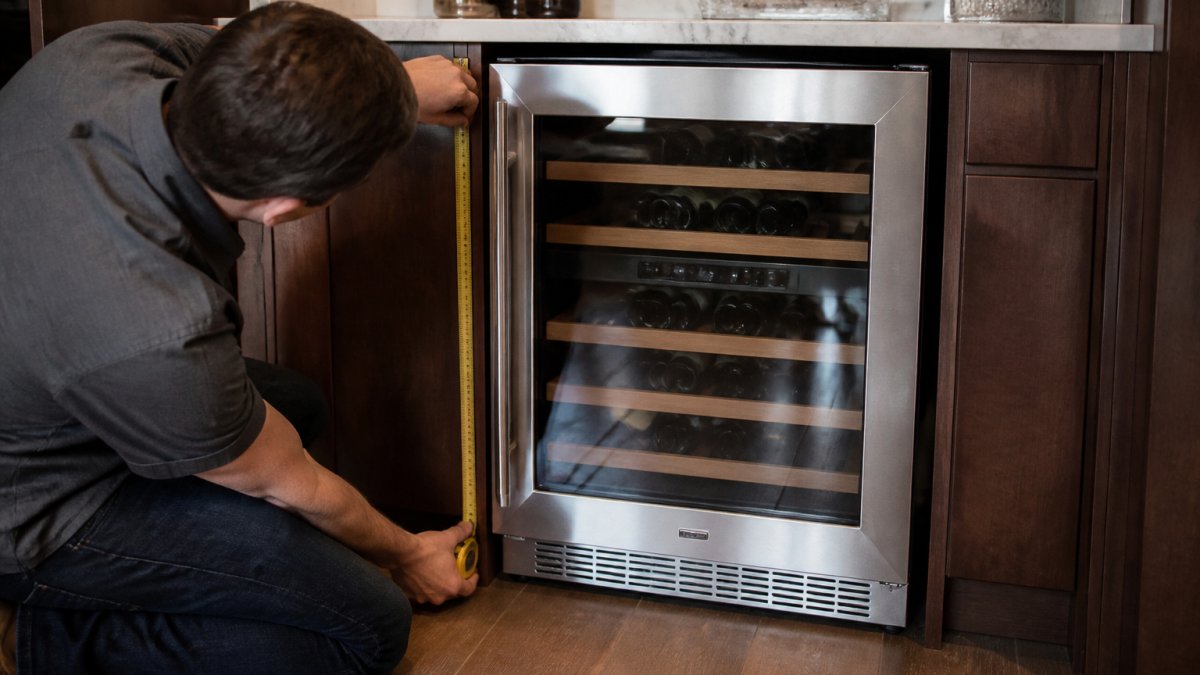
Measure the opening, not the sticker
Manufacturers list nominal dimensions, but the cutout is what matters. Check the manual for the exact cutout required for the model you choose. Depth is the one buyers forget: a built-in unit that sits proud of the cabinet by two inches ruins the flush look. Confirm the depth from the cabinet face to the back wall, then add the door handle depth and any rear clearance the manual requires.
Ventilation and heat clearance
Front-venting built-ins still need a path for warm air to escape. Most manuals call for a minimum opening at the toe-kick and a gap so heat does not recirculate. The manual overrides any general rule of thumb. Boxed into a tight cavity with no front grille, the unit runs hot, works harder, and shortens its own life. Freestanding units need open air on the back and sides, so avoid pushing them into a closet or cabinet alcove.
Electrical and placement
A wine refrigerator needs a dedicated grounded outlet, and most full-size units draw enough current that sharing a circuit with a microwave or coffee maker invites nuisance trips. Place the outlet so the cord is not pinched behind the unit, and Keep the unit away from direct sun, heat vents, ovens, and dishwashers, a unit beside an oven fights the room all day and never holds temperature evenly.
Under-counter and door swing
Under-counter models sit low and work well in a bar run, but confirm the door swing clears drawers, walkways, and adjacent cabinet doors. A reversible door helps, but the hinge side still needs clearance for the handle. Measure the door swing before you commit to a location.
If you want a concrete model to measure against, the Kalamera 24-inch built-in 46-bottle dual zone wine cooler supports both built-in and freestanding installs, with front ventilation and a fully finished black cabinet. It measures 33 inches high, 23.4 inches wide, and 22.4 inches deep.

Dual-Zone Wine Fridge vs Single Zone: Matching Temperature to Bottle
A dual-zone wine fridge holds two separate temperature ranges in one cabinet, letting you store reds and whites at their own settings. A single-zone unit holds one range throughout, which suits collectors who drink mostly one style or who keep everything at a steady cellar temperature.
Kalamera 24'' Built-in 46 Bottle Dual Zone Wine Cooler →
The case for dual-zone is practical. Reds and whites are often served at different temperatures, so one shared setting can force a compromise.
The case for single-zone is simplicity and steadier conditions. Examine a freestanding smart cooler with zone and temperature details to compare against dual-zone options. Fewer zones mean less machinery and less to go wrong.
What Luxury Construction and Finish Quality Actually Buy You
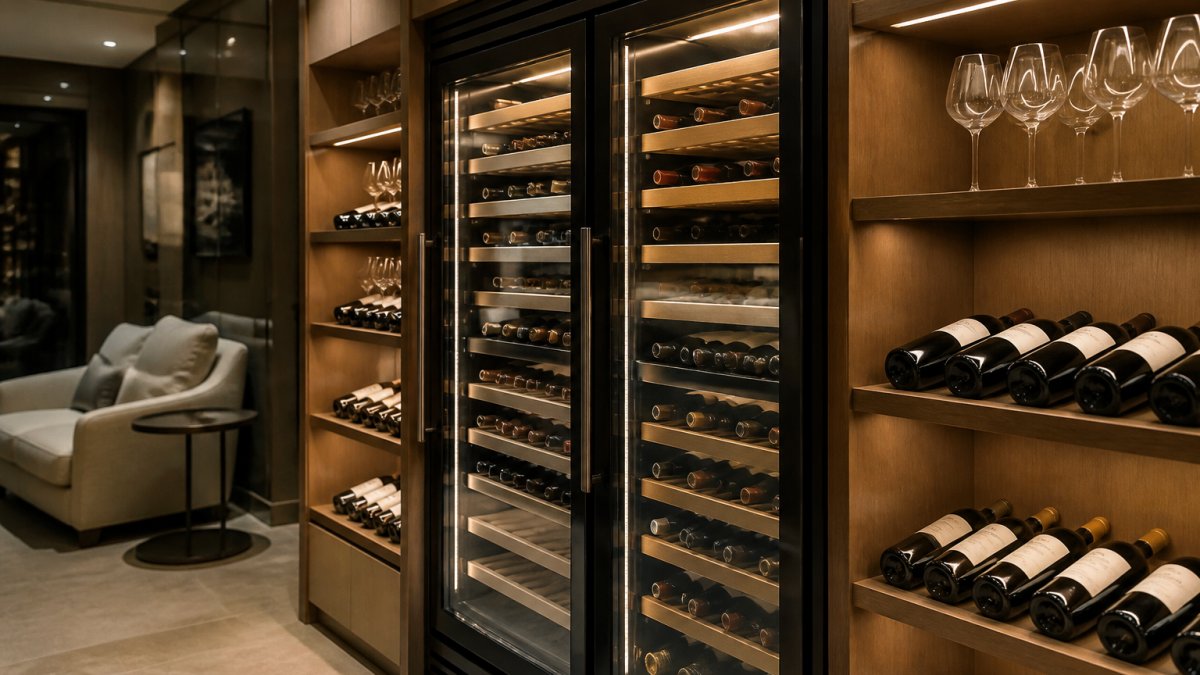
Higher-end construction is generally associated with steadier conditions, quieter operation, and a finish that holds up over time. The premium is the insulation, the door glass, the shelving, and the compressor.
What most guides miss is that these details are functional, not cosmetic:
- Double-pane tinted glass blocks UV light that degrades wine
- Low-vibration cooling protects sediment and flavor over time
- Beech wood or glass racks hold bottles steady and slide cleanly
- Carbon filters keep odors from reaching the cork
- Reversible doors let the unit fit the room instead of the reverse
The finish matters too. A stainless trim and soft interior lighting turn storage into display, which is the point of a luxury bar.
Total Cost of Ownership, Climate, and Collection Security
The sticker price is the smallest part of the cost. Total cost of ownership includes energy use, replacement parts, warranty coverage, and getting the install right the first time. A cheaper unit that runs hot or fails early costs more than a well-built one, so compare units on five-year cost, not shelf price.
What actually drives running cost
A wine refrigerator runs year-round, so its power draw matters over time. Check the rated power draw listed for the model you are considering. Compare using the unit's annual energy use figure if published, multiplied by your local electricity rate. A unit that draws 150 watts and runs a third of the time uses far less than one that never catches up because it sits in a hot garage. Placement changes energy use more than the spec sheet does.
Maintenance, repairs, and service life
Service life varies by unit and build. Check the warranty and maintenance guidance for the model you are considering. Ask whether the compressor and sealed system are covered, how long the warranty runs, and whether service is in-home or requires shipping the unit back.
Climate and room conditions
Climate and room conditions decide how hard the unit works. Check the rated ambient operating range in the manual, and avoid placing the unit in a hot garage or beside an oven. Place it away from direct sun, heat vents, and warm appliances. In a humid room, watch for condensation on the glass and confirm the unit can manage it.
Security and collection management
Security matters once the collection has value. Look for a keyed lock or built-in child lock, and place the unit set back from walkways. For a serious collection, consider inventory tracking, a spreadsheet or wine app recording bottle, vintage, and location, and check for a temperature alarm or door-ajar alert. Consistent humidity protects corks from drying, so humidity control is worth the premium for long-term storage.
On energy, check the unit's rated power draw against how you will actually run it. A second fridge running year-round adds up, and the U.S. Department of Energy publishes guidance on appliance energy use if you want to compare running costs.
Match the Unit to Your Room and Collection
The right unit disappears into the room and gets out of the way of your collection. Match three things and the decision makes itself: capacity to your growth, installation type to your space, and zones to your bottle mix.
A short checklist before you buy:
- Capacity is 25 to 30 percent above your current count
- Dimensions confirmed against the actual opening, including door swing
- Ventilation clearance matches the unit's requirements
- Zone count fits your red-white-sparkling split
- Glass is tinted and double-paned
- Racks hold your bottle formats, including magnums
- Lock and placement protect a valuable collection
- Finish and lighting suit the room, not just the showroom
For a larger, furniture-grade piece, the Nuvia 158-bottle wooden wine cooler cabinet pairs a wood exterior with vacuum insulation doors and adjustable shelving. For a statement display in a smaller footprint, the Nuvia 102-bottle smart multi-tier wine cabinet turns the collection into a focal point.


Choosing luxury wine refrigeration comes down to matching the unit to your collection, your room, and how you actually live.
Frequently Asked Questions
How do I choose the right wine fridge capacity?
Count every bottle you own, then add 25 to 30 percent for the next two years of buying. A 46-bottle dual-zone unit like the Kalamera 24-inch is built to fit undercounter, while a 102-bottle cabinet such as the Nuvia multi-tier model suits a larger collection. Measure your tallest bottle before you commit.
Do I need a single-zone or dual-zone wine fridge?
A dual-zone wine fridge matters when you store reds and whites together or keep bottles for aging alongside bottles you drink now. Two independent zones let you set different temperatures for white and red in the same cabinet. If you drink one style almost exclusively, a single-zone unit cools more evenly for the money. The Kalamera 46-bottle model runs dual zones from 40 to 66°F, which covers both serving and short-term storage.
How much ventilation does a built-in wine cooler need?
Follow the manufacturer's clearance spec, not a generic number. Front-vented units draw air through the toe kick, so the cabinet opening needs open space at the front and no blocking panel behind the vent. The ZLINE Touchstone is built for flush cabinetry. Follow the manufacturer's clearance guidance for the model you choose.
What features matter most in a high-end wine cooler?
Look at four things: temperature consistency, vibration control, UV protection, and shelf quality. The Kalamera uses dual circulation fans to distribute cool air, offers low-vibration cooling, and has a double tinted glass door. Slide-out beech or glass racks make bottles accessible without pulling neighbors out. Extras like carbon filters, reversible doors, and child locks separate a luxury wine refrigeration purchase from a basic cooler.