 how-to
How to Maintain an Electric Cigar Humidor for Freshness
Last Updated: October 27, 2026
Quick Summary
To keep an electric cigar humidor fresh, aim for about 70% relative humidity and 70°F, keep those readings steady, and check them weekly. Verify the cabinet's built-in sensor against a separate hygrometer monthly, since sensors drift over time.
- Aim for near 70% relative humidity and keep it steady.
- Hold the cabinet near 70°F and maintain good airflow.
- Season a new or empty cabinet for several days before loading cigars.
- Check the readings weekly and confirm the door seal is closed.
- Compare the cabinet display with a separate hygrometer every month.
Table of Contents
- What Optimal Freshness Requires: Humidity, Temperature and the 70/70 Guideline
- Electric Cigar Humidor Settings to Check Before You Load Cigars
- How to Season an Electric Humidor Before Adding Cigars
- Electric Humidor Humidity Calibration: Checking Sensor Accuracy
- How to Clean a Cigar Humidor Cabinet Without Damaging the Cedar
- Routine Maintenance Calendar: Weekly, Monthly and Seasonal Tasks
- Troubleshooting by Symptom: Fluctuations, Condensation, Power Loss and Mold
- Schedule Your Humidor Check and Set Up Your Cabinet Right
- Frequently Asked Questions
Keeping an electric cigar humidor in good shape comes down to a few things done on a steady schedule. Get the humidity and temperature right, check the readings, and clean the cabinet before problems start.
What Optimal Freshness Requires: Humidity, Temperature and the 70/70 Guideline
Most hobbyists aim for 70% relative humidity (RH) and 70°F. That pairing is often called the 70/70 rule.
Stability matters as much as the target number.
Watch for these basics:
- Relative humidity: Aim near 70% RH and keep it steady.
- Temperature: Hold the cabinet near 70°F.
- Air movement: Good airflow keeps humidity even from shelf to shelf.
Electric Cigar Humidor Settings to Check Before You Load Cigars
Check your settings before a single cigar goes inside.
Confirm the humidity setpoint, the temperature setpoint, and the fan operation. Make sure the door seal closes tightly. A gap lets moist air escape and makes the unit work harder.
If you need more room for a growing collection, the C150A Raching Electric Cigar Humidor Cabinet, 600 Cigars is one option to compare. It is priced at $1,399.00.

How to Season an Electric Humidor Before Adding Cigars
A new cabinet, or one that has sat empty, needs seasoning before cigars go in. Seasoning lets the cedar and interior surfaces take on moisture and stabilize.
Follow these steps:
- Plug in the unit and set it to your target settings, around 70% RH and 70°F.
- Let it run empty for several days so the humidity settles.
- Check that the readings hold steady before you add anything.
- Load your cigars once the environment is stable.
Electric Humidor Humidity Calibration: Checking Sensor Accuracy
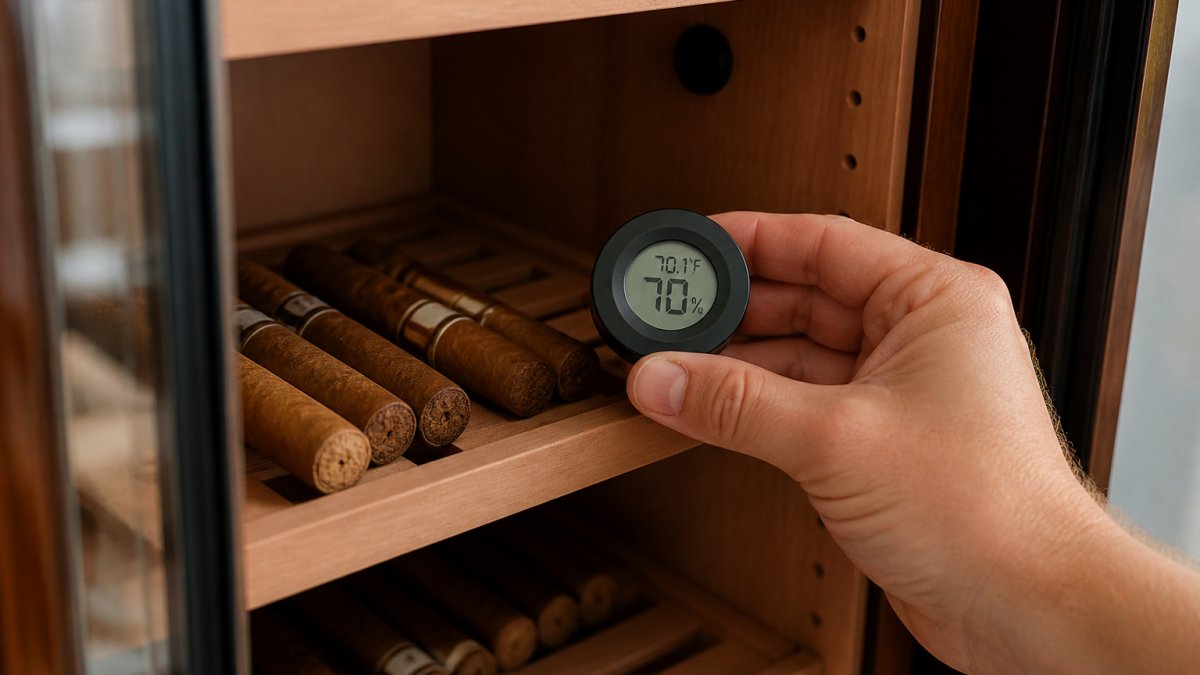
Built-in humidity sensors in electric cabinets drift over time. A display reading of 70% RH can be off by several points, which means your cigars may be sitting drier or wetter than the panel suggests. Competitors rarely address this for electric cabinets specifically, so treat sensor verification as a core maintenance task rather than an afterthought.
Why built-in sensors drift
Most cabinet sensors are resistive or capacitive elements exposed to constant humidity and occasional cleaning. Over months, dust, mineral film from tap water, and repeated wet-dry cycles shift their output. Fan-driven cabinets can also develop uneven readings if the sensor sits in a dead zone away from airflow. The result is a slow, silent offset that a weekly glance at the display will never catch.
The salt test: a reliable reference check
The salt test is the standard field method for verifying a hygrometer. It relies on a known public fact: a saturated salt solution in a sealed container holds roughly 75% RH at room temperature.
- Fill a small bottle cap or shallow dish with table salt and add a few drops of distilled water until it is damp but not dissolved.
- Place the salt dish and your independent digital hygrometer inside a sealed zip-top bag or small airtight container.
- Let it sit for 6 to 8 hours at a stable room temperature.
- Read the hygrometer. If it shows 75% RH, it is accurate. If it reads 72%, it is reading 3 points low and you should apply that offset when interpreting its numbers.
Use a separate, calibrated digital hygrometer as your reference, not the cabinet's own display. The cabinet sensor is the thing you are testing.
Comparing the cabinet display to a reference hygrometer
Place the calibrated reference hygrometer on a middle shelf near where your cigars sit, close the door, and let it stabilize for at least 4 hours without opening the cabinet. Then compare:
- Consistent offset: The cabinet reads 3 points higher than the reference every time. This is drift you can manage by mentally applying the offset, or by recalibrating the panel if the unit allows it.
- Random swings: The gap changes each time you check. This points to a failing sensor, a fan problem, or a seal leak rather than simple drift.
- Large gap (more than about 5 points): Stop trusting the display and rely on the reference hygrometer until the sensor is serviced or replaced.
Recalibrating or servicing the sensor
Many electric cabinets allow a calibration offset through the control panel, check your manual for the exact button sequence. If your unit has no calibration function, or if the offset keeps growing after adjustment, contact the manufacturer for a replacement sensor. Do not keep compensating manually for a sensor that is drifting quickly; that usually means the element is near the end of its life.
When to replace rather than recalibrate
Replace the sensor if the offset exceeds roughly 5 points, if readings jump erratically between checks, or if the display freezes at a single number. A sensor that will not respond to calibration is a maintenance liability, not a convenience.
How to Clean a Cigar Humidor Cabinet Without Damaging the Cedar
Cleaning keeps mold and residue from building up, but cedar is soft and can be damaged by harsh products.
- Remove cigars and place them somewhere safe at stable humidity.
- Wipe interior surfaces with a soft, lightly dampened cloth.
- Avoid soaking the cedar or using harsh chemicals.
- Dry surfaces fully before returning cigars.
- Clean the door seal and glass so it closes well.
A common mistake is over-wetting the cloth. Too much moisture can cause the cedar to warp or leave water in corners.
Routine Maintenance Calendar: Weekly, Monthly and Seasonal Tasks
Weekly
- Check the humidity and temperature readings.
- Confirm the door is sealed.
- Look for any moisture pooling in the cabinet.
Monthly
- Compare the cabinet display with a separate hygrometer.
- Wipe down interior surfaces.
- Check the fan and vents for dust.
Seasonal
C150A Raching Electric Cigar Humidor Cabinet I 600 Cigars →
- Recheck settings as the room climate changes.
- Inspect the door seal for wear.
- Review the manual for any recommended service intervals.
If your collection is large, the C380A Electronic Commercial Cigar Humidor Cabinet, 1,500 Cigars is built for bigger storage needs. It is priced at $2,699.00.

The article's maintenance schedule breaks down into three cadences, summarised below.
| Interval | Task | Purpose |
|---|---|---|
| Weekly | Check humidity and temperature readings | Catch changes early |
| Weekly | Confirm the door is sealed | Keep moisture inside |
| Weekly | Look for moisture pooling | Spot condensation problems |
| Monthly | Compare display with a separate hygrometer | Verify sensor accuracy |
| Monthly | Wipe down interior surfaces | Prevent residue buildup |
| Monthly | Check fan and vents for dust | Maintain airflow |
| Seasonal | Recheck settings for room climate | Adjust to changing conditions |
| Seasonal | Inspect door seal for wear | Maintain a tight seal |
Troubleshooting by Symptom: Fluctuations, Condensation, Power Loss and Mold
Electric cabinets fail in predictable ways. Use this symptom map to move from what you see to the most likely cause and the corrective action, rather than guessing at settings.
Humidity keeps swinging
Likely causes: a door seal that is not seating, a room that swings in temperature, a fan that has stopped circulating, or a sensor that is drifting.
What to do:
- Close the door on a strip of paper and pull it out. If it slides freely, the seal is not gripping and should be cleaned or replaced.
- Check that the cabinet is not in direct sun or next to a heat source. Room temperature swings push the compressor and humidifier into constant correction.
- Confirm the internal fan is running. A stopped fan creates humidity pockets and makes the controller overcorrect.
- Run the salt-test comparison from the calibration section to rule out sensor drift.
Condensation forms inside
Likely causes: humidity set too high for the room temperature, poor airflow, or a cabinet that is overfilled so air cannot move.
What to do:
- Lower the RH setpoint by about 2 to 3 points and watch for 24 hours.
- Clear space around vents and the fan intake. Cigars stacked against the back wall block circulation.
- Wipe up standing moisture and dry the affected cedar before it warps.
Power loss or equipment failure
Likely causes: an outage, a tripped breaker, a failed fan, or a cooling system fault.
What to do:
- Keep the door closed during an outage. A well-sealed cabinet holds humidity for hours, and every opening releases the buffer.
- After power returns, let the cabinet run for several hours before trusting the display, then verify against your reference hygrometer.
- If the fan or cooling system fails, move cigars to a backup humidor or sealed container with a humidification pack until the unit is repaired.
- Check the breaker and the unit's own fault codes in the manual before assuming a major failure.
Mold appears
Likely causes: sustained humidity above target, poor airflow, or loading damp cigars.
What to do:
- Remove affected cigars immediately and isolate them from the rest.
- Clean the interior with a lightly dampened cloth and dry thoroughly.
- Correct the humidity level and confirm airflow before reloading.
- Inspect the door seal and sensor; mold usually signals that conditions have been too wet for too long, not a one-time spike.
Dry wrappers or cracking
Likely causes: humidity running below target, a sensor reading high so the cabinet is actually drier than shown, or frequent door openings.
What to do:
- Verify the sensor against a reference hygrometer before adjusting anything.
- Check that the humidifier reservoir is filled with distilled water and the wicking element is not crusted.
- Reduce how often and how long the door stays open.
Schedule Your Humidor Check and Set Up Your Cabinet Right
If you are setting up a new cabinet or upgrading, browse the full range of cigar humidors at Retreat Elite. Our team is available by phone and email to help with specifications and setup questions.
Frequently Asked Questions
What humidity should an electric cigar humidor be set to? Most hobbyists aim for around 70% relative humidity, paired with a temperature near 70°F.
How often should I check my electric humidor? Check the readings weekly and compare the sensor against a separate hygrometer monthly.
Do I need to season a new electric humidor? Yes. Run the empty cabinet at your target settings for several days so the cedar and interior stabilize before adding cigars.
Frequently Asked Questions
Do I need to season an electric humidor?
Yes. A new electric humidor and its cedar lining should be run for a period before cigars go in, so the wood can absorb moisture and the interior can settle near 70% relative humidity. Set the unit, let it stabilize for several days, confirm the readings on a calibrated hygrometer, and only then load your cigars. Loading too early exposes the cigars to swings in humidity while the cabinet is still adjusting.
What are the ideal settings for an electric cigar humidor?
The widely used target is 70% relative humidity at about 70°F, often called the 70/70 guideline.
How often should you refill an electric humidor's water reservoir?
Check the reservoir at least once a week and refill it when the level drops below the minimum mark. Use distilled water or the humidification solution recommended by the manufacturer, since tap water can leave mineral deposits on the membrane. Clean and refresh the water periodically, and replace the wet membrane on the schedule in your product manual or sooner if it looks worn or stops holding humidity.
How often should you check the humidity in an electric humidor?
Check the humidity and temperature readings at least weekly, and daily for the first few weeks after seasoning or after moving the cabinet. Compare the built-in sensor against a separate calibrated digital hygrometer every month or two. Large swings, a reading that drifts from your hygrometer, or condensation on the glass are signals to investigate before the cigars are affected.